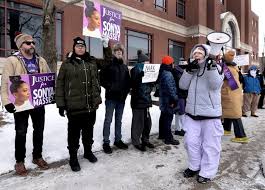
 It was the week of the “Big Freeze” and protesters were huddled outside Sangamon County Courthouse. The weather was frigid–so frigid my pipes had burst just days before–but the people in Springfield had come out in full force. Icy wind whipped my face and my cheeks as I walked from my car to the building. The protesters were clad in suitable garb for the weather–they wore scarves and puffy coats as they chanted slogans and held up signs.
I had an inkling of what they were there for, but nobody inside the courthouse had told me of the day’s event. I asked one protester as I walked by, “Is this for Sonya Massey? Is the sentencing today?”
“Yes,” a young protester told me, “Grayson is being sentenced today.”
“What’s the max?” I replied, and he told me twenty years. I nodded and continued on inside–I was already running late.
When I approached security, I noticed more officers than normal at the checkpoint. There were even a couple of sheriffs I had never seen before, so I assumed they were jailhouse staff assisting the normal crowd. The protesters didn’t look like they were going to do anything disruptive, but I suppose you never know with these situations, and the county had decided to take precautions in case of any disturbance. I said something about the protesters outside to a sheriff, then hurried up to floor 5 to sign in for my shift.
The 5th floor was abuzz with commotion among the staff. Apparently things had gotten pretty crazy with this trial in the past, so much so that it was moved to Peoria for part of the proceedings. My site supervisors urged me to “stay safe,” although they didn’t seem like they were too worried about the result of the trial.
“You’ll probably be fine today,” they told me, “but tomorrow might get a little hectic.”
Although the Judges always listen to each side’s arguments on the final day of trial, I had the impression that Cadagin knew what he was going to decide. I suppose that, sure, something the defense or prosecution says the day of might sway the judge one way or another, but after hearing the evidence and reading every affidavit before the trial, it would be pretty hard to not come to a foregone conclusion. Still, no one told me for definite that Grayson would be sentenced one way or another, only that protests were probably not going to get very ugly.
I filled up my coffee cup and left the 5th floor to go to the 6th, where my office is. It isn’t exactly an office really–more of a conference room that was renovated to fit JusticeCorps needs, but I quite like the old meeting room, even if the door stop falls apart every week or so, and I have to tape it back together.
When I entered the elevator, the room was more packed than I had ever seen before. One old man stood out in a purple suit. There were security guards in the elevator too, but I managed to squeeze in just enough so that we could travel to the next floor.
When I left the elevator, though, I felt like a celebrity. Instantly cameras were shoved in my face, and it seemed like the entire floor had become a media machine. Cameras swiveled, following the crowd of people as we walked. I felt very exposed until I realized they were not trying to photograph me, but the man in the purple suit I had noticed earlier. As the man and the crowd of people he was with disappeared into the courtroom nearby, I stood awkwardly, a bit out of the way. All the cameras and equipment were right in front of where I needed to go.
“Hey, uh, I work here,” I said to the mass of reporters, “mind if I just.. Yeah… squeeze past ya there…” The reporters didn’t really say much to me, but they made a space for me to squeeze through, careful not to let my laptop bag slap into any tripods. I was eventually able to make it to my office when I realized that, if I was hardly able to get through the media, there was no way any patrons seeking a Stalking No Contact could get to me in my office.
Up until that point, I hadn’t fully considered sitting in on the trial. A large part of me wanted to, believe me, but I also wanted to be in my usual spot, in case any self-represented litigants needed my help. With all the media stuffing up the place, though, I realized I had no excuse to stand by. History was in the making, and I’m not ashamed to say I wanted to be a part of it.
So, I left my laptop bag and coffee (regrettable, but drinks are not allowed in the courtroom) on my desk and grabbed my notebook so I could write and draw whatever happened in the event.
Before going into the courtroom, I wanted to make sure it was ok, so I went up to one of the sheriffs to ask. It seemed a bit crazy to just walk into such a high-profile case, especially with all the people outside who were definitely not attending the trial. So, I walked up to a sheriff and asked her if the public was allowed to sit in on the trial.
“Yeah,” she responded, a bit rudely, “if you can find yourself a seat.” I had always been friendly with the sheriff, so I was a bit taken aback by the coldness of her response. I hadn’t really considered how law enforcement probably felt about the trial. I wondered if it felt, to them, like they were on trial themselves. Maybe they worried a hard sentence would make it harder for them to do their job–harder for them to defend themselves if put in a dangerous situation. Or maybe it was more of a fraternity thing, a sort of unifying response where cops back cops, even ones in controversial situations. Or, maybe, she just hadn’t had enough coffee today and was annoyed having to deal with the large crowds. I can’t tell you what she was thinking that day, but her response to my question made me think of all these things at once.
Regardless of the welcome I had been given, I was told the courtroom was open to the public, and the public I was. I opened the big courtroom doors and started going to the left, only to be quickly ushered to the right by security. “Left side’s family only,” a sheriff told me, “the public goes on the right.”
After apologizing for my ineptitude (the family side was clearly labelled) I made my way to the right side. Finding a seat was not hard; while the right side was so packed with family members I could hardly see space in between them, there were several empty benches to choose from on the right. I considered sitting in the back, but chose to sit up front around a group of white people. A lady slid in next to me, and I began to survey the room. I saw the head of court security with a bright yellow “sheriff” on the back of his police vest. I saw Cadigan’s clerk, and I saw the lawyers sat on each side of the courtroom. The press was there too, although, at the time I had assumed they were lawyers by the way they dressed–usually, in the Sangamon County Courthouse, you could tell who was a lawyer that way. The better looking someone’s attire, the more likely they were to be a card-carrying member of the bar association, but, today, many of the lawyers were outshone by the TV personalities in their fancy clothes and well-make-upped faces.
I wish I had taken more notes of the trial but, unfortunately, a lady next to me asked me if I had a spare piece of paper to give her. “You’re lucky, this is my last one,” I said to her, grinning. While I would have liked to hold onto the page for myself, my duty as a JusticeCorps fellow is to the patrons, f irst and foremost, so I gave her my last piece of paper and now I have much less notes to go by when recounting this part of the story.
Eventually, Judge Cadagin entered the room, and the clerk told us to all rise. We did, and Cadagin soon asked us to sit down again, as is customary in the courtroom. Most of the time, hearings are pretty rote and mundane, but with such a large crowd in attendance, Judge Cadigan looked alert and attentive. I could have sworn he looked right at me when he walked in, and I suppose I stood out, especially with my long hair in the middle of such an empty part of the court room. Cadigan looked away and addressed the crowd before us. He said something about the seriousness of the trial, and told the gallery that, while he was sure there were high emotions surrounding the trial, he expected there to be no outbursts and for the crowd to be quiet and respectful.
Once that was out of the way, the doors opened and Grayson entered. The Sangamon County jail is connected to the Sangamon County Courthouse, a feature I realized pretty early into my career as a JusticeCorps fellow. Grayson entered with his state-issued garb. It always surprises me a little to see the stripy uniforms, but they really are just how they are portrayed in the movies, although the stripes are more orange than black, and a number is printed on the back of each inmate. Grayson looked much thinner and hairier than photos I had seen of him previously. He had a long beard that sank all the way to his chest, and his skin looked chapped and unhealthy.
Grayson sat next to his lawyer, and Judge Cadagin refreshed everyone’s memory of the court’s previous decision. He had been found guilty of second degree murder and today was the hearing to decide how long he would be put away. The judge asked Grayson some questions to assure he was of sound mind and body before letting the lawyers disclose the result of a presentence report. Although some other matters were attended to, the main part of the presentence investigation concerned some medical records that would not be available for public access, but that the defense wanted to bring up later on in the hearing.
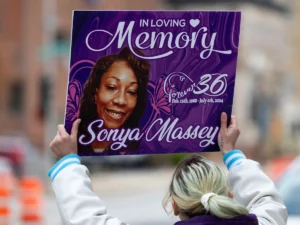
After the report was out of the way, Judge Cadagin opened the floor for victim impact statements, where victims affected by Sonya Massey’s murder could take the stand to discuss how Massey’s death affected them and their livelihood.
The first person that took the stand was Sonya’s daughter Summer. She looked very young, and it saddened me to see someone of her age without a mother. Summer seemed shy on the stand–she read from a piece of paper like a student called on to read in class when they didn’t want to. She was very quiet, and I saw Judge Cadigan looking at the head sheriff to see if the mic was working properly. It was a bit hard to hear her statement, but I remember hearing her express her inability to comprehend life without her mother by her side. Much of her testimony was in the form of a question: “How am I supposed to live my everyday?” “Why did this happen?” “It doesn’t feel like this was real.” I can’t imagine what such immense loss must feel like, at such a formative age. When you’re in high school, you’re still trying to figure out what life is all about. Senseless tragedy can rock your worldview. You realize that assumptions, like your mother always being there for you, can be proven false in an instant, and it can feel almost impossible to piece reality back together when such a foundational premise has been proven null.
After Summer gave her statement, she returned to the gallery quietly as court staff fiddled with the mic. The next victim to approach the stand was Sonya’s son Malachi, and his statement was one of the more unique testimonies. Unlike his sister, grandfather, and grandmother, Malachi chose to give his testimony off the cuff. Despite his lack of a written speech, he tread much of the same ground as Summer, talking about how he didn’t feel like his life was real and that he does not know what to do. Unlike Summer’s more somber testimony, Malachi seemed angry. He wasn’t yelling or anything, but he had a rebellious energy magnified by his more impromptu recitation, as if he was saying “My mom is dead. Screw your formalities.” Shortly after his speech, he left the room for quite some time.
The third speaker had a familiar face, and I quickly realized why the security guards had been in the elevator earlier, and why the cameras had swiveled when I reached the 6th floor. The man in the purple suit was Sonya Massey’s father. He was an old man with white hair and a white beard, but he spoke with the frivolity and vigor of a man half his age. An NPR reporter told me afterward that he was a pastor, and you could tell by the way he carried his voice; it rang out strong and true across the entirety of the courtroom, and it made me wonder about Sonya Massey herself, and how it must have felt being raised by this bastion of a man–I’m sure instances of reprimand must have been pretty scary. The father spoke with much love for his daughter. He called her a bright, intelligent woman who had many gifts to still give the world, gifts that would no longer be received. He called her murder a great evil, and he stared Grayson in the eye as he said this. The father also spoke of a federal law that would make the background checks of law enforcement more strict, so that an officer with Grayson’s past could not be hired again.
The final victim impact statement was done by Massey’s mother. Like Summer, she was more quiet and reserved as she read off her speech, but, at many points, her voice shook with emotion. I can’t remember if she cried during her testimony, but I do know for sure that many in the congregation did. The mother’s testimony was more mild than what came before, but her misery was the most evident. She had to pause at many points, unable to continue reading, overcome with the gravity of her daughter’s demise. Her final statement, that she gave while staring directly at Sean Grayson was the most memorable of the entire ordeal. “Sean Grayson,” she said, her words caught in her throat, “I rebuke you in the name of Jesus.” Those were her last words before she left the stand.
After the victim statements came the recommendations from both parties of the trial. The prosecution spoke first, listing off the reasons why the maximum sentence should be sought, citing egregious police conduct, and the magnitude of suffering Grayson had caused. The state’s argument was much shorter compared to the defense.
Grayson’s attorney wore a fine pinstripe suit as he urged Judge Cadigan to sentence Grayson lightly. He claimed the criteria for maximum sentence had not been met: that Grayson had not used his status as a police officer insidiously, that Grayson’s prior bouts of misconduct were a long time ago, and that his conduct did not show a depraved indifference to human life. Even knowing my prior convictions, I began to wonder if Grayson would be sentenced for very long. The lawyer informed us of the law, and, he claimed, the circumstances did not entail the maximum sentence of twenty years.
The medical reports from earlier came into play as well. It was revealed for the first time that Sean Grayson was suffering from colon cancer. The cancer had gotten so out of hand that it had spread to his liver and lungs. I began to wonder if Grayson would live to see the end of his sentence, even if Cadigan gave him the minimum. Grayson’s attorney argued that Grayson was not receiving proper medical treatment from within the state-run facility he was imprisoned in.
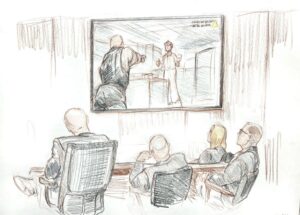
At one point, Grayson’s lawyer turned to look directly at Massey’s family. I can’t remember what the man was saying when he looked over at the bereaved, but the interaction did not go over well. A great uproar came about from the crowd, and order was called by Judge Cadagin, who then told the man to keep his eyes on the stand.
Finally, the defense finished their recommendation. I believe the state made a statement about the jailhouse medical facilities being adequate to care for Grayson’s condition, but I do not remember exactly the order of the proceedings. All I know is that after the defense finished, Grayson was given the opportunity to say his piece.
The judge instructed Grayson to face the bench as he spoke. Little emotion was expressed as he did so. It was hard to tell how Grayson felt, but he apologized for his unprofessionalism. He did not cry and he stood still as he faced the judge. I wondered if he still believed he was in the right, a police officer who made a decision, albeit a bad one, but a decision that was perfectly rational to make. Or, maybe, he did feel an immense guilt for what he did that night, but did not want to seem culpable, as this could be seen as a reason to give him the maximum sentence. Maybe his lawyer had told him what to say or maybe he would have choked up if he had looked at Massey’s family in the eye. It’s impossible to tell, and I wonder if even Grayson can fully comprehend how that night affected and will continue to affect him for the rest of his life. Regardless, the victim’s family still looked angry, although I doubt there was anything he could have said to make things right.
It was after Grayson spoke that Judge Cadigan gave his decision. He gave a long pause before he spoke, but you could tell he had been thinking it over for a long time.
“Twenty years,” Cadigan said, and the courtroom erupted in cheers. Massey’s family rose in jubilation, and order had to be called once more. Even I was swept up in the chaos, although I didn’t say anything or leave my chair. The joyful energy was palpable and my chest felt light and airy.
But, at the same time as the raucous cheers from the left side of the room, I heard something soft and quiet. A woman behind me burst into tears. I heard her sobbing and I was reminded of my mother in a state of anguish. She cried and she sniffled, and I felt a rush of guilt for my prior jubilation. I then realized, for the first time, that I was seated right next to the entirety of Grayson’s family. What was ecstasy for one half of the room was absolute misery for the other.
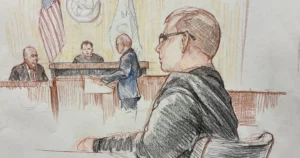
Grayson’s lawyer said he would be appealing Cadagin’s decision, then Court security escorted everyone out of the courtroom, starting with Massey’s family first. After leaving, I chatted with a couple reporters a bit, asking how things went in Peoria and discussing what had occurred in the courtroom. Massey’s family came out, and the father made a statement to the press, dressed in his purple suit. I saw a sketch artist making drawings of the proceedings, and I later saw one of these drawings on national news. The rest of the day was pretty standard for me, although a bit slower than usual in my office.
Later that night, I had no one to talk to about the proceedings, so I took to TikTok to read and reply to comments people made about the trial. Most of them said that Grayson’s sentence had not been long enough, although I wondered whether they knew it was the maximum allowed in cases of second degree murder. It felt strange knowing such intimate details surrounding the sentencing, yet no one was curious about how Grayson had acted, the cheers from the gallery, or the cadence of Judge Cadigan. They were more interested in the big picture issues, like how many years he was sentenced and whether the proceeding should be taken as a “win” or not.
I think the whole scenario is a tragedy, and I wonder what the political reaction from either side of the aisle says about our country. I remember very clearly the cries of joy expressed by Massey’s family being juxtaposed by the sobs from Grayson’s. Nothing, even a twenty year–a hundred year–sentence will bring Sonya Massey back, but what we can do is make sure our law enforcement is qualified so that a tragedy such as this one will not happen again in the future. I recall the new law Massey’s father spoke about that champions better background checks for law enforcement. The law has already been enacted in Illinois, but there is a push to make it federal as well. If Grayson was never made a cop, he would have never shot Sonya Massey, and he would have never been sentenced to prison. All this could have been avoided, but it wasn’t, and now both families have to deal with the consequences.
Author: Eric Waldschmidt – Sangamon County Fellow